
Gold's Summer of Discontent: Why the Quiet Period Is When Fortunes Are Made
June 2026
Gold is doing exactly what gold does after a historic blow-off top. It's consolidating. It's frustrating the impatient. It's transferring metal from weak hands to strong hands. And most importantly, it's setting up the next leg of this bull market while nobody is watching.
After the parabolic frenzy of December 2025 and January 2026, when gold briefly touched above $5,500 in some spot markets before the inevitable reckoning, the metal has settled into a well-defined consolidation range between roughly $4,400 and $4,800. For those keeping score at home, that's approximately 18% below the all-time highs set just a few months ago. To the casual observer, this might look like a broken rally. To those of us who have been through these cycles before, this is textbook bull market behavior, even with the geopolitical twist that has created a once-in-a-decade buying opportunity.
The Recovery That Was — and the War That Wasn't
What the headlines don't tell you is what happened between that January peak and today's prices. After the initial blow-off top and correction in late January, gold did what resilient assets do: it recovered. By late February, gold had clawed its way back to $5,250, rebuilding technical structure and shaking off the weak hands who had panicked at $4,800. The path back to new all-time highs was clearing. Institutional buying was returning. Physical demand from Asia remained robust.
Then came March 2026 and the U.S.-Israel attack on Iran. What followed was a cascade that had nothing to do with gold's fundamentals and everything to do with its liquidity. When geopolitical crises hit emerging markets, gold does exactly what it was designed to do: it becomes the asset you sell to survive.
The Iran war and the subsequent disruption of the Strait of Hormuz created an immediate crisis for Middle Eastern and emerging market economies. Energy prices spiked. Currencies came under pressure. And central banks that had spent years accumulating gold were suddenly forced to liquidate. The scale of this selling was unprecedented. Turkey's central bank sold approximately 58 to 70 tonnes of gold in a matter of weeks, worth over $8 billion, to defend the collapsing lira. This represented one of the largest drops in Turkish gold reserves in seven years. The sales were not strategic rebalancing. They were emergency triage.
But Turkey was not alone. Across the Middle East, central banks facing currency crises and inflation spikes were forced to tap their gold reserves. Just today (June 6th), there are rumors circulating that India has been forced to sell 10 tons of gold, in an effort to defend the Rupee. The very institutions that had driven gold's bull market through fifteen years of relentless buying became forced sellers almost overnight. Gold-for-foreign-currency swaps proliferated. Stop losses were triggered. Algorithmic trading systems amplified the moves. What started as necessary liquidation became a self-reinforcing cascade that drove gold from $5,250 to below $4,300 in a matter of days, at one point touching $4,098.
This is the part of the story that mainstream financial media misses entirely. They see the price decline and assume gold's thesis is broken. Nothing could be further from the truth.
Downside Risks We Cannot Ignore
Gold's role as a safe haven is not broken. It is being demonstrated in real time. When the proverbial poo hits the fan, gold is liquid. It can be sold quickly. It can be swapped for dollars, euros, or yen to defend currencies, pay for energy imports, or stabilize collapsing bond markets. That is not a bug in gold's design. That is the feature.
We have to be completely honest here though. Significant risks remain on the table. If fighting in the region reignites or the Strait of Hormuz stays closed for an extended period, we could face a prolonged energy crunch. That scenario raises the real possibility of stagflation, with high inflation running alongside slowing economic growth. If this drags on long enough, it may well bring about a global recession. In that kind of environment we could see outright panic in global bond markets, with investors dumping even the safest government debt in search of liquidity. In a true structural reset, nothing would be safe from big drops. Equities, bonds, real estate, and even gold could face further sharp pressure in the short term as forced selling and fear take over.
We are not predicting this black swan outcome, but it would be irresponsible to ignore the possibility. Gold could fall another 10% from here. A break below $4,400 could see a quick move to $4,200, and if that level fails, we could retest the $3,800 to $4,000 zone that held during the March spike. Anyone who tells you there is no risk right now is not being straight with you.
Why Our Long-Term Conviction Remains Unchanged
Even with those near-term risks, our conviction in gold's longer-term future has not wavered. When this forced selling ends, and it will end as energy markets adjust and trade routes eventually reopen, we expect central banks en masse to return to massive purchases to rebuild reserves to comfortable levels. The countries that sold tonnes in March will need to buy more to restore confidence once the dust settles. The central banks that swapped gold for dollars will need to reverse those swaps.
What makes this liquidation phase so compelling for long-term investors is that gold has never been more central to the global monetary system. In early 2026, gold overtook U.S. Treasuries to become the world's largest foreign reserve asset by value, the first time this has happened since 1996. Gold's share of total official reserves climbed to 27% by the end of 2025, with central banks now holding close to $4 trillion worth of gold. This historic shift, driven by fifteen years of relentless central bank buying, the sanctions on Russia that exposed the political risk of dollar reserves, and genuine concerns about U.S. fiscal discipline, has not reversed. The structural trend toward gold as the preferred reserve asset remains intact.
As I wrote in my March 12, 2025 article "Gold's Ascent to $5,000," "No one has a crystal ball. Maybe this time it will in fact be different and gold will finally be retired as a store of wealth. However judging by over 3000 years of recorded economic history, every previous experiment in fiat (paper money backed by promises alone) has ended badly. I don't expect this time to be any different."
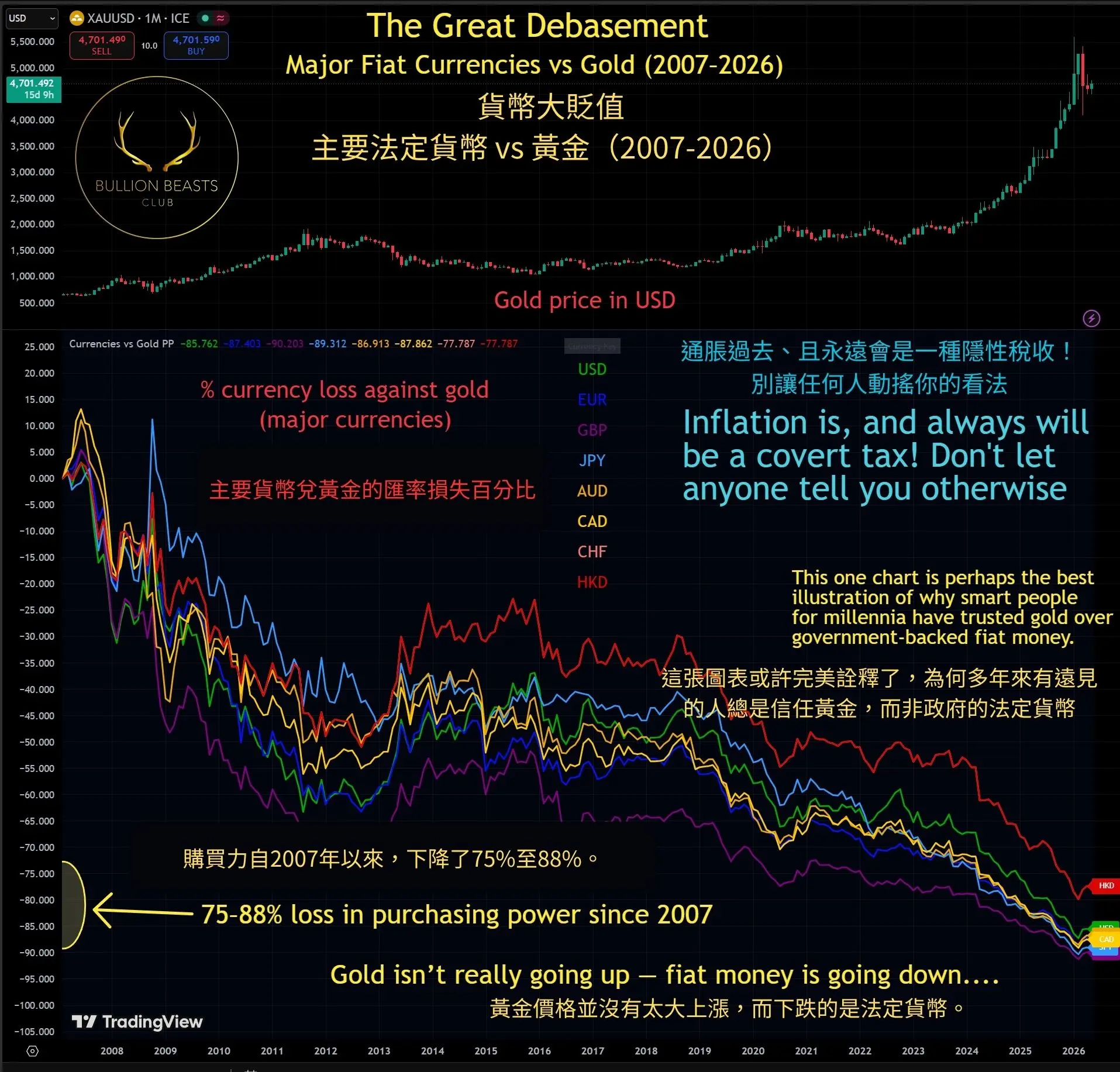
Fig 1. Graph shows 7 major currencies against the price of gold. All are in deep decline
After any near-term chaos settles, gold tends to reassert itself as the ultimate fiscal anchor, a role it has played for millennia. There have been over 250 recorded examples of fiat currencies, paper money backed only by government promises, throughout history. Every single one has eventually failed. This one will be no different in our opinion. Debt and war, generally in that order, is the combination that has always broken the camel's back. With global debt now well north of $315 trillion and geopolitical instability rising, the pressures are only mounting.
Gold Seasonality
We are currently in one of gold’s traditionally weakest periods of the year. From April through the end of June, precious metals have historically experienced seasonally soft performance. Physical demand from key Asian markets typically slows, while European and American investors are often distracted by summer holidays. Trading volumes tend to thin out during this window.
This seasonal weakness is well-documented over the past five decades and may persist for several more weeks.
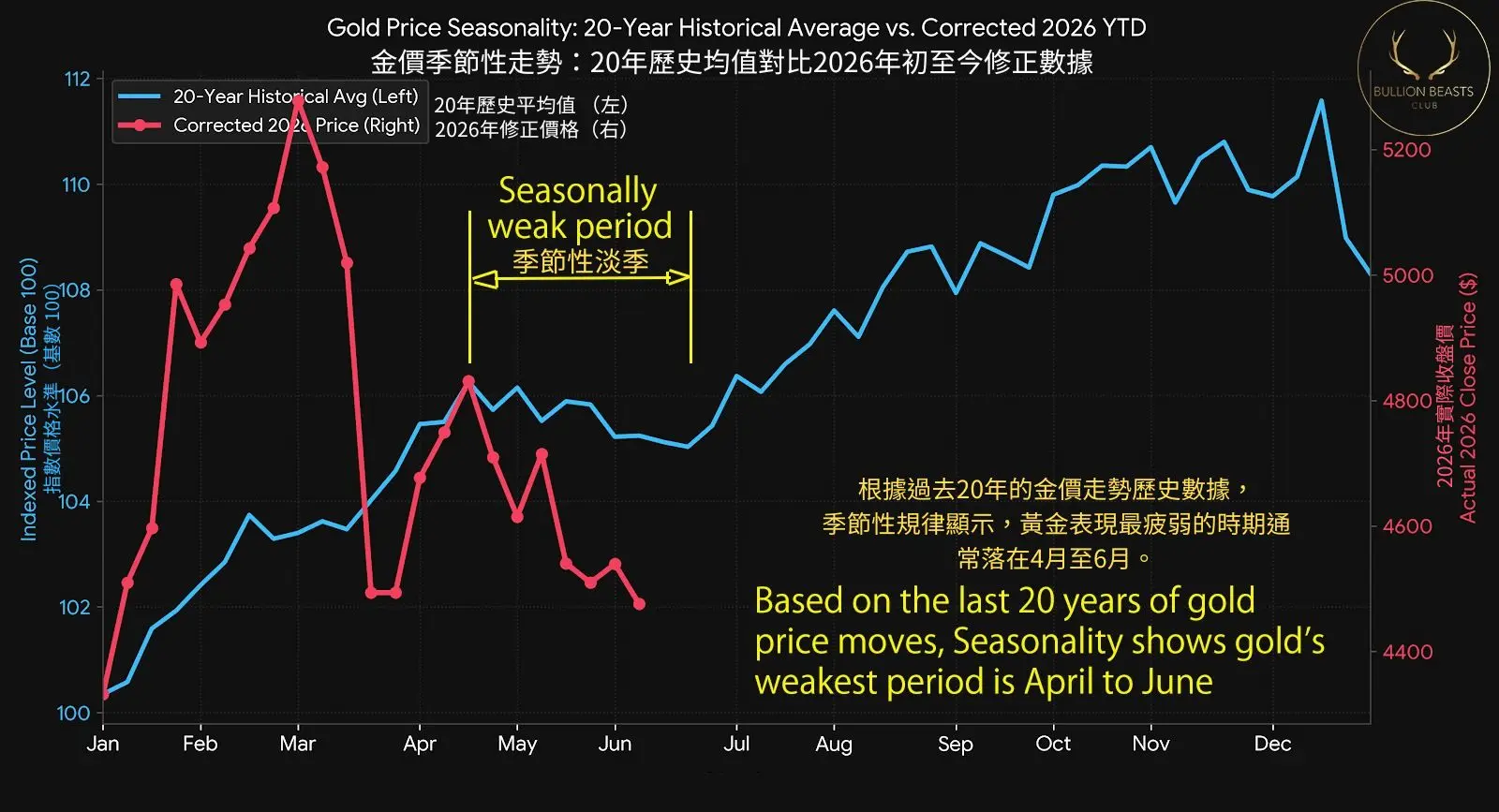
Fig 2. The April–June period has often delivered some of the weakest average returns. In fact, over the last 20 years, this window has been negative on average.
That said, seasonal patterns only matter in the short term. They reflect human behavior, distraction, and apathy rather than any shift in underlying fundamentals. July and August have historically marked a turning point for gold, as momentum builds toward India’s Diwali festival in the autumn.
India’s government is actively discouraging gold purchases this year in an effort to reduce currency outflows and support the Rupee. This may dampen seasonal buying to some extent. However, in our view, the broader macro picture remains as compelling as ever: ongoing currency debasement, unsustainable global debt levels, persistent central bank buying, and elevated geopolitical risk.
The Psychology of Buying High and Selling Low
If there is one lesson that separates successful investors from the masses, it is this. The crowd is almost always wrong at the extremes. Right now the crowd is making a classic mistake. Think back to December 2025 and January 2026. Gold was going parabolic. Every financial news channel was running gold tickers. Social media was filled with charts showing gold heading to $6,000, then $7,000, then $10,000. The FOMO was palpable. Retail investors who had ignored gold at $3,200 or $4,000 were suddenly desperate to buy at $5,000 and above. Premiums on physical metal exploded.
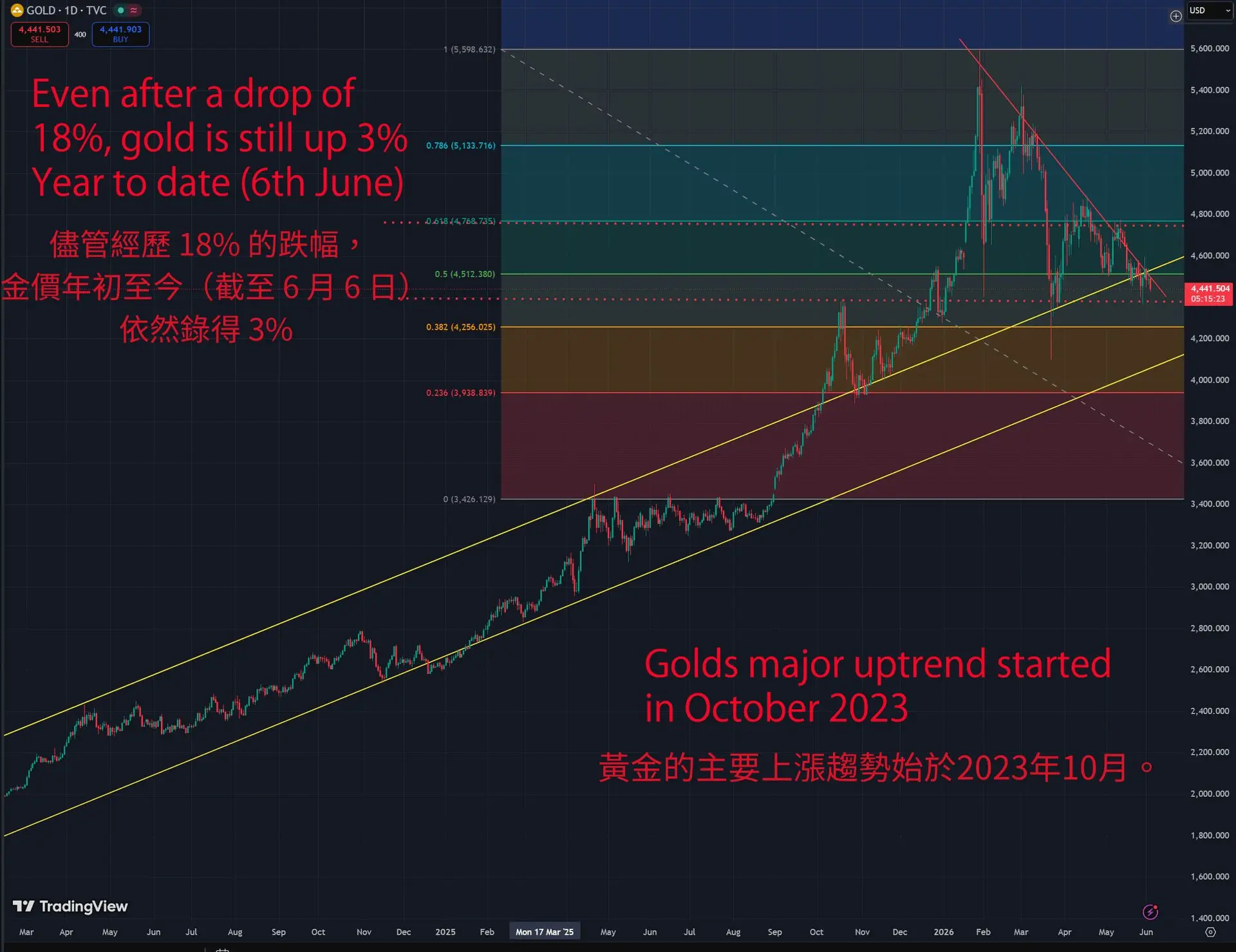 Fig 3. Graph shows that even after an 18% fall, gold is still only just getting back into the top of the upwards channel that started in October 2023.
The psychology was textbook mania. People were not buying because they deeply understood currency debasement or central bank balance sheet expansion. They were buying because the price was going up.
As I noted in my October 23, 2025 article "Gold Isn't a Tech Stock—And That's the Point," when an asset whose value is rooted in stability starts swinging 10% monthly, "it's not fundamentals driving the price. It's speculation." The rally was fueled by fear, momentum, and technical breakouts—but it lacked the fundamental catalysts to justify such velocity. In short, "gold's price got ahead of its narrative."
Fast forward to today. Gold has found a base. The technical structure has repaired itself. The froth has been wrung out. The macro fundamentals remain as strong as ever. And yet investor demand has evaporated. The same people who were desperate to buy at $5,200 are now reluctant to touch it at $4,600. The financial media that couldn't stop talking about gold in January is now focused on AI stocks and crypto again.
This is the paradox of investing in real assets. The best time to buy is when you do not want to. The best time to sell is when you cannot imagine selling.
This current consolidation between $4,400 and $4,800 represents something important. As I wrote in my December 2, 2025 article "Gold in December 2025: Consolidation, Conviction and the Path to New All-Time Highs," "$4,000 has transformed from overhead resistance into substantial structural support—a development few would have imagined when we first outlined that target in early 2025." It is the construction of a new, higher base built on the ashes of forced liquidation rather than speculative excess.
Our Updated Outlook
While near-term volatility could produce further downside, we believe any meaningful dips from these levels may represent one of the last great buying opportunities for gold this decade. Our updated expectation is that gold reaches $7,000 to $8,000 by 2028 as the forces of currency debasement, central bank demand, and geopolitical realities continue to play out.
For investors who are underweight gold, the current consolidation is a gift. You do not need to deploy all your capital at once. Dollar-cost averaging into weakness over the summer months is a perfectly valid strategy. But waiting for the perfect entry point is usually a mistake. The perfect entry was $3,200 in 2025 or $4,000 later that year. The second-best entry point is today.
For those already positioned, the discipline is straightforward. Hold. Do not let short-term volatility shake your conviction. Respect the longer-term trend. Add on weakness if it is presented. Allow the broader fundamental picture to do the heavy lifting.
Remember J.P. Morgan's century-old wisdom that I quoted in my May 1, 2025 article "Gold is Down 9%, Should You Buy?": "Gold is money. Everything else is credit." That truth does not change just because the price swings 10% in a month. Gold isn't a tech stock. It doesn't generate earnings. It doesn't innovate. And that's exactly why it matters.
The metal is moving from weak hands to strong hands right now, a process that has characterized every major precious metals bull market of the past fifty years. The question is which hands are yours?
Keep shining.
Jamie Turnough
CEO, Bullion Beasts
Disclaimer: This is not personalized financial advice. Gold prices are volatile and carry risk of loss. Do your own research or consult a licensed advisor. Past performance does not guarantee future results.